
Turn on suggestions
Auto-suggest helps you quickly narrow down your search results by suggesting possible matches as you type.
Showing results for
EN
Turn on suggestions
Auto-suggest helps you quickly narrow down your search results by suggesting possible matches as you type.
Showing results for
- English
- :
- Knowledge Base
- :
- Installation & update
- :
- Performance review with M1
Options
- Subscribe to RSS Feed
- Mark as New
- Mark as Read
- Bookmark
- Subscribe to Topic
- Printer Friendly Page
- Report Inappropriate Content
Performance review with M1
on
2021-02-09
10:30 AM
- edited on
2026-09-03
11:21 AM
by
 Koussay Farah
Options
- Subscribe to RSS Feed
- Mark as New
- Mark as Read
- Bookmark
- Subscribe to Topic
- Printer Friendly Page
- Report Inappropriate Content

Apple officially unveiled their first ARM chip designed specifically for Mac, the M1 processor, in November 2020. The first three models received this processor are the Macbook Air, the Macbook Pro 13", and the Mac Mini.
This article will focus on the performance and compatibility of Archicad and BIMcloud running on M1 chip via Rosetta 2. At the time of writing, our test model is the latest Macbook Pro 13" with:
- M1 chip with 8-core CPU (4 performance cores and 4 efficiency cores) and 8-core GPU
- 8GB of unified memory
- 512GB of SSD storage
General performance of the M1 chip
In the first public release of Apple Silicon on Mac, the M1 chip targets the best CPU performance per watt. Thus these machines are optimized for power efficiency. Incredibly long battery life is their biggest strength, but that doesn't mean the M1 chip is weak. It performs similar to recent Intel's mobile processors in terms of CPU power even with programs that are not optimized for ARM, and much better than Intel's integrated graphics solution.
Compatibility
Since Archicad and BIMcloud are not yet optimized for ARM architecture, they will still be running as Intel x86 applications via Rosetta 2. They may initially take a little longer to open while Rosetta 2 translates them.
Given the short time frame, we were only able to carry out limited sets of tests. Nevertheless, the performance is similar to what you expect on Intel-processor models. No severe problem sticks out during our tests, using the latest updates for Archicad 24, Archicad 25, and BIMcloud 2022.1. You can find the list of the currently known issues in the last section.
CPU Performance
The M1 found in the Macbook Pro 13" is equipped with:
- 8-core CPU with 4 performance cores and 4 efficiency cores
- 8-core GPU
The most significant difference between the first three models with M1 is: the Macbook Pro 13" and Mac Mini contain a fan, which helps to sustain higher performance during a longer period of time. The Macbook Air does not have a cooling fan and also has one fewer GPU core in the lowest configuration. Under long heavy tasks, like rendering, the chip will slow itself down as temperature rises (the so-called throttling behavior).
Archicad uses the CPU for most operations (like Processing Elements, Generating 2D Views, Rendering). We performed the same sets of tests to compare the performance of M1 with various Intel-based Macs: the late-2019 Macbook Pro 16", the iMac 5K in 2017, and the late-2016 Macbook Pro 15". Their specifications can be found below:
| Macbook Pro 13" | Macbook Pro 16", late 2019 | iMac 5K, 2017 | Macbook Pro 15", late 2016 | |
| CPU | M1 | 9th Gen Intel Core i7 2.6 GHz (6-core) | 7th Gen Intel Core i7 4.2 GHz (4-core) | 6th Gen Intel Core i7 2.7 GHz (4-core) |
| RAM | 8GB of Unified memory | 32GB | 32GB | 16GB |
| HDD | 512GB SSD | 1TB SSD | 512GB SSD | 512GB SSD |
| GPU | Integrated Graphics | AMD Radeon PRO 5500M with 4GB of GDDR6 memory | AMD Radeon Pro 580 with 8GB of GDDR5 memory | AMD Radeon PRO 460 with 4GB of GDDR5 memory |
The results from our tests are quite positive:

*The tests are performed with Archicad 24 Update Preview 4000
Memory (RAM)
The M1 chip features a unified memory architecture: the system memory is built directly into the chip. It is shared by both processor cores and graphics cores.
This brings the benefit of accessing the same data without copying it between multiple pools of memory inside the system, reducing the latency. At the same time, it is currently limited to 16GB, which is adequate for small to medium models or having 1 or 2 Archicad instances opened. Bigger projects can easily consume lots of memory, especially if many Views are open simultaneously or when rendering.
16GB will suffice for running BIMcloud Manager and BIMcloud Server with Small firm size (5-15 active users). For a higher number of active users and more complex models, 16GB won't be enough.
Graphics Card
The graphics solution is integrated into the M1 processor. Official information from Apple suggests that the M1's eight-core GPU can simultaneously handle nearly 25,000 threads and deliver up to 2.6 teraflops. This puts the M1 on the same level as Nvidia GeForce GTX 1050 Ti or the AMD Radeon RX 560. In our Archicad 3D navigation tests, although M1 registers a slower result, it still provides smooth navigation.

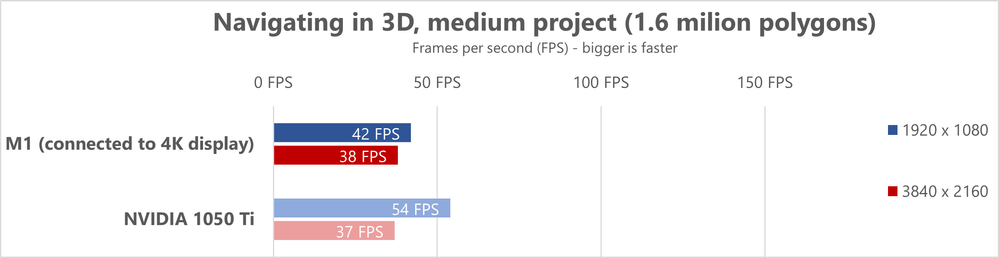
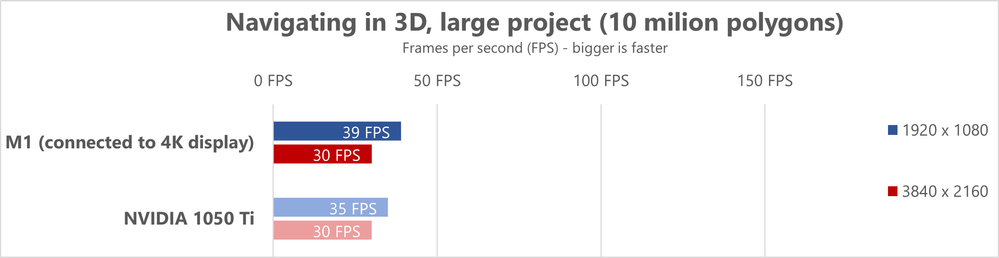
*The tests are performed with Archicad 23 Update Preview 6000
Storage (SSD)
The SSD storage equipped in Macs is usually pretty fast. It is no different here, but currently, M1-equipped machines can only be configured with up to 2TB of SSD storage.
Limitations
Despite the good test results, the M1 chip does have certain limitations:
- Currently, the M1 can only be configured with up to 16GB of unified memory. This can be a drawback when handling big models.
- External GPUs are not yet supported on this platform. We also do not know whether they will be supported in the future.
- The Macbook Pro and Macbook Air with M1 currently support only one external display with up to 6K resolution at 60Hz; whereas the Mac Mini with M1 can support maximum two displays at either 6K or at 4K resolution.
- Windows emulation is not officially supported yet on Apple Silicon for Mac.
Recommendation
You may consider buying a Mac with M1 chip if:
- You are upgrading from a previous 13-inch Macbook Pro or Macbook Air, or if you are fine with a smaller screen and would like to try out the latest technology available.
- Battery life and mobility are essential.
- You only handle small or medium models with the machine.
- Multiple displays are not necessary.
- External GPUs are not necessary.
- Only run BIMcloud in small firm size.
You shouldn't buy a Mac with M1 chip if:
- You are using a recent Macbook Pro 16", Mac Pro, or any recent iMacs and won't need a smaller model.
- 16GB of RAM or 2TB of internal SSD is not enough for your work.
- Extra power from a dedicated graphics card is needed.
- You usually work with large models.
- The machine will be connected to a power source most of the time, and portability is not essential.
- You need multiple displays for your work.
- You need to run BIMcloud in medium or large firm size.
Known Issues
Archicad is stuck in the background after closing
Affected version(s): Archicad 22, 23, 24 | Severity: solved in an OS update | ID: DEF-2864
Issue
Archicad freezes after closing Archicad. We can see in the Activity Monitor that Archicad becomes "Not responding" in the background after the Work Environment disappears from the screen.
Cause
Archicad is frozen in Rosetta.
Solution
Archicad only freezes after all works have been saved, thus there should not be any loss of data. The issue solved with the latest update of macOS 11
Archicad crashes when importing Point Cloud
Affected version(s): Archicad 22, 23, 24 | Severity: workaround applicable | ID: DEF-3618
Issue
Archicad crashes while importing a point cloud or opening a project file with point cloud embedded.
Cause
M1 chip doesn't support Geometry Shader, which the point cloud currently uses for rendering.
Solution
By disabling Geometry Shader, Archicad won't crash when handling Point Cloud.
Didn't find the answer?
Check other topics in this Forum
Back to ForumRead the latest accepted solutions!
Accepted Solutions

Suggested topics
- Archicad trial activation troubleshooting checklist in Installation & update
- How to use GDL algorithms and parameters to generate procedural terrain in Archicad in Libraries & objects
- How to create custom Symbol Fills with embedded fills in Archicad in Modeling
- How to model horizontal cable railings and wall‑mounted handrails with the Railing tool in Modeling
- Clean, trustworthy and easy to read - MEP documentation tips in MEP
