Apple introduced the update to their first SoC for the Mac, the M1 Pro and M1 Max, that focused on professional users in October 2021. The M1 Max is the most powerful version of the M1 generation, followed by the M1 Pro. Both processors have the same number of CPU cores, while the M1 Max has more graphics performance with double the GPU cores and memory bandwidth.
The article will focus on the performance of Archicad in different M1 chips. Please keep in mind Archicad is still running on Apple ARM platform through Rosetta 2. More information about Graphisoft’s support with Apple ARM processors can be found here.
General performance of the M1 Pro/Max
The underlying architecture of the processors does not differ from last year’s Apple M1 System-on-a-Chip (SoC), but their performance is greatly improved. As these chips target professional users, the CPU performance has been boosted with double the high-performance core (in the high-tier models for both M1 Pro and M1 Max).
Powering the graphics side, we have up to 16-core GPU in the M1 Pro and up to 32-core GPU in the M1 Max.
With M1 Pro, we can configure it with up to 32GB of memory, whereas this number goes up to 64GB in case of M1 Max.
These help to bring the performance of the M1 Pro and M1 Max closer to the level of high-end prosumer laptops and desktops. While the performance of these new chips is increased greatly compared with the first M1, they still have a very good level of power efficiency.
Compatibility
Since there were not a lot of changes in the architecture of the M1 Pro/Max vs the original M1, there won’t be any difference in terms of compatibility with our products. Please note that they are still using Rosetta 2 to run on these processors.
CPU Performance
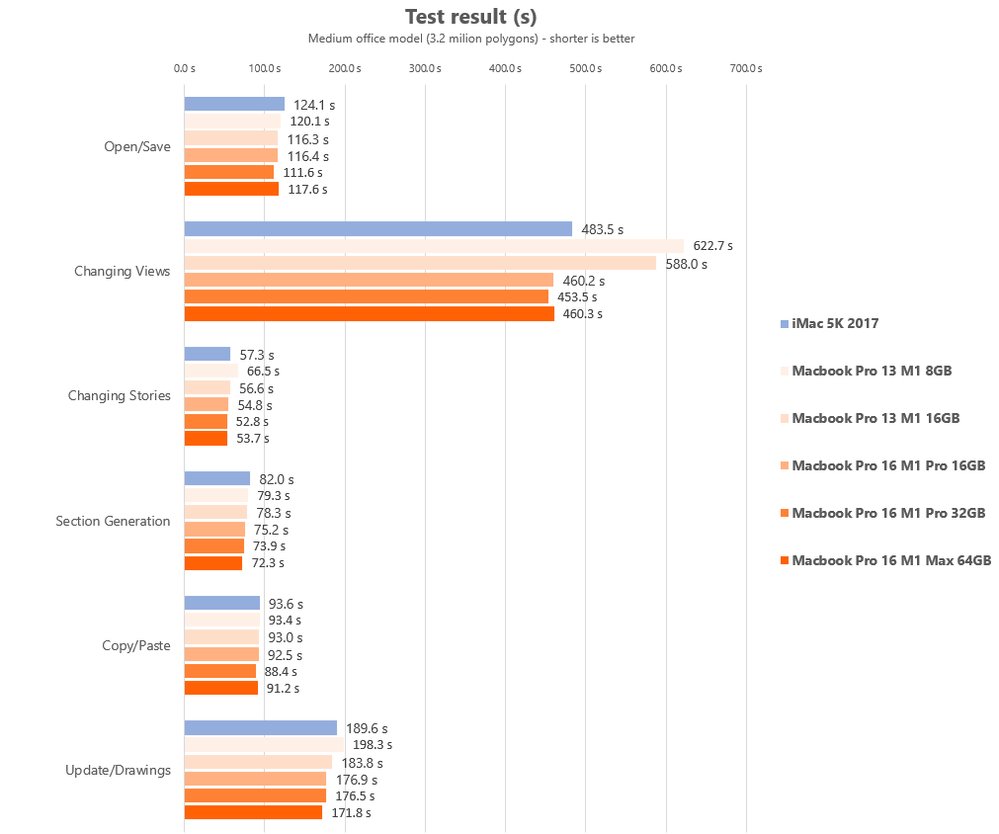
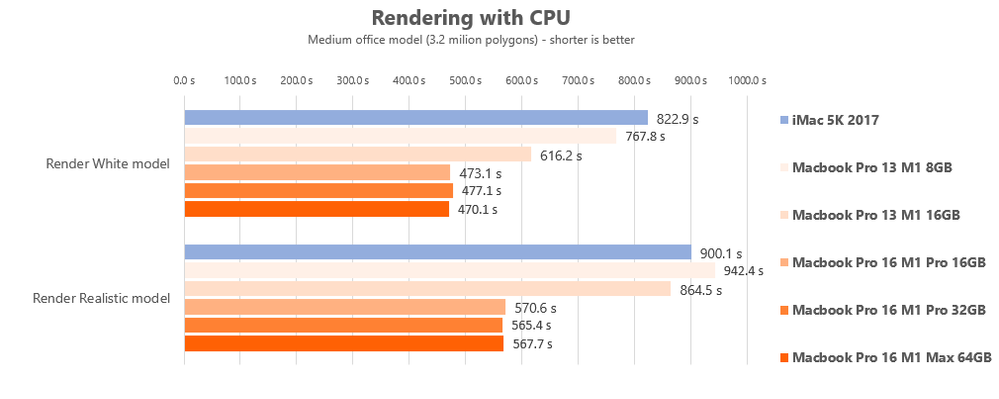
Archicad uses the CPU for most operations (like Processing Elements, Generating 2D Views, Rendering). We performed the same sets of tests to compare the performance of different M1 and M1 Pro/Max variants, as well as an Intel-based iMac 5K as a reference. Their specifications can be found below:
| |
CPU |
RAM |
HDD |
GPU |
| iMac 5K 2017 |
7th Gen Intel Core i7 4.2 GHz (4-core) |
32GB |
512GB SSD |
AMD Radeon Pro 580 with 8GB of GDDR5 memory |
| MacBook Pro M1 13" 8GB |
M1 with 8 CPU core |
8GB |
512GB SSD |
M1 with 8 GPU core |
| MacBook Pro M1 13" 16GB |
M1 with 8 CPU core |
16GB |
512GB SSD |
M1 with 8 GPU core |
| MacBook Pro M1 Pro 16" 16GB |
M1 Pro with 10 CPU core |
16GB |
512GB SSD |
M1 Pro with 16 GPU core |
| MacBook Pro M1 Pro 16" 32GB |
M1 Pro with 10 CPU core |
32GB |
1TB SSD |
M1 Pro with 16 GPU core |
| MacBook Pro M1 Max 16" 64GB |
M1 Max with 10 CPU core |
64GB |
1TB SSD |
M1 Max with 32 GPU core |
The M1 Pro and M1 Max (with 10-core configuration) share exactly the same architecture and clock speed, thus if we consider raw CPU performance, there should be no difference between them. For long and intensive tasks where multithreading is utilized, the M1 Pro/Max’s finishing time is up to 45% faster than the original M1, and it even surpasses the Intel-based Macs in some tasks.
Memory
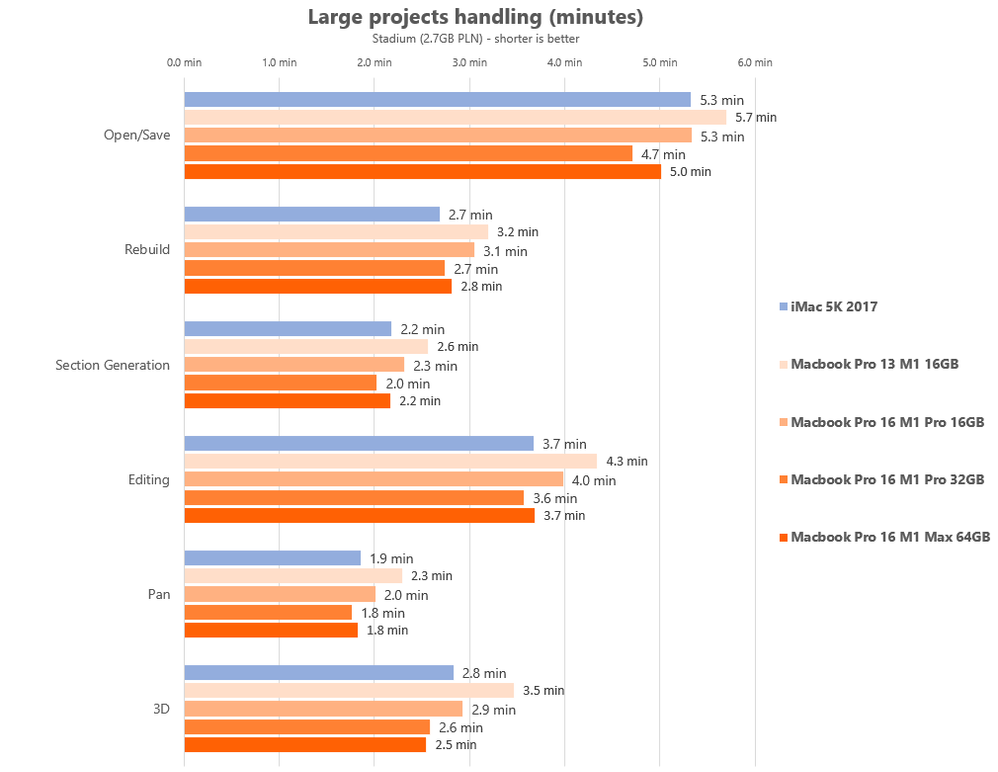
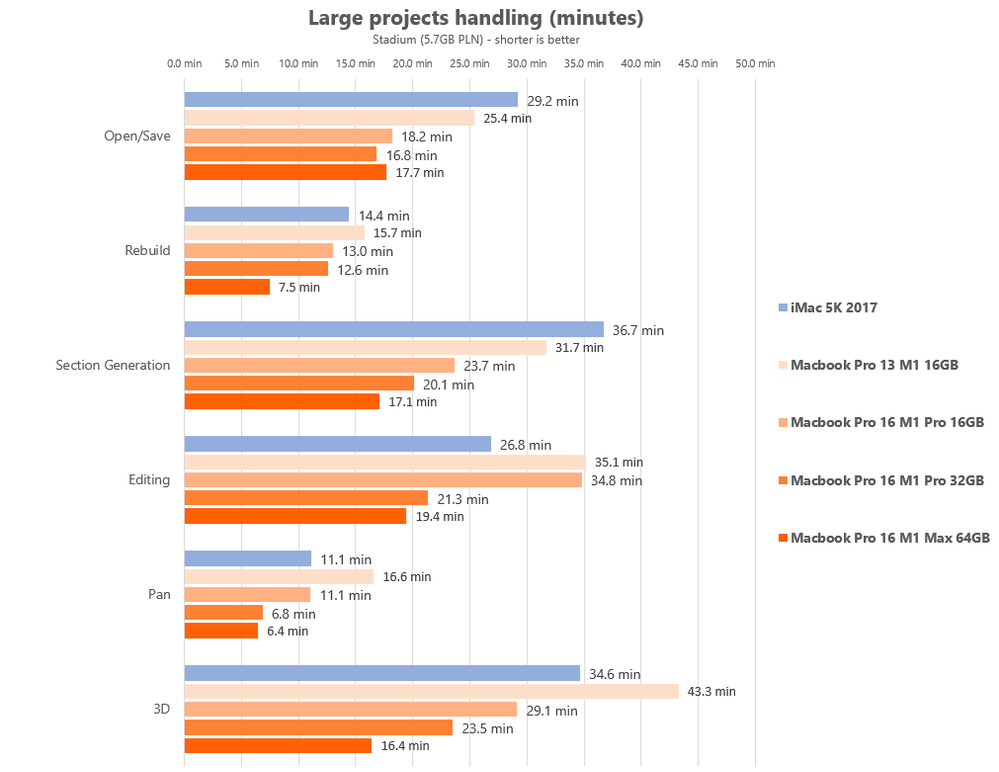
With a maximum configuration of 64GB of memory from the M1 Max, working with large projects is a lot more feasible now thanks to the larger memory. We saw a noticeable improvement in handling large projects when enough physical memory is provided and less swap memory is used.
GPU Performance
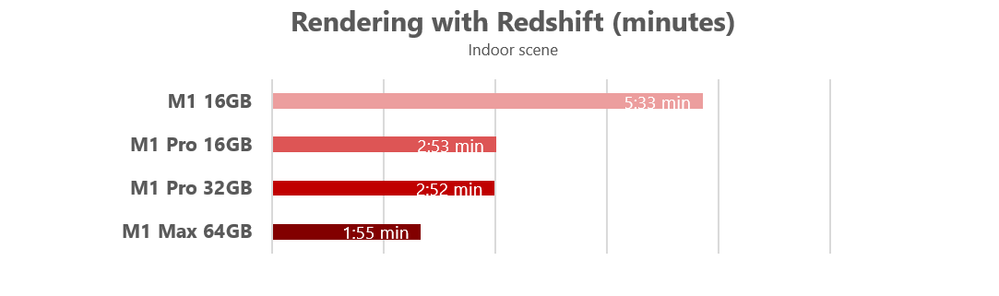
Redshift rendering and 3D navigation are greatly benefited from the extra GPU power.
From the test, we can see a much shorter rendering time with Redshift.
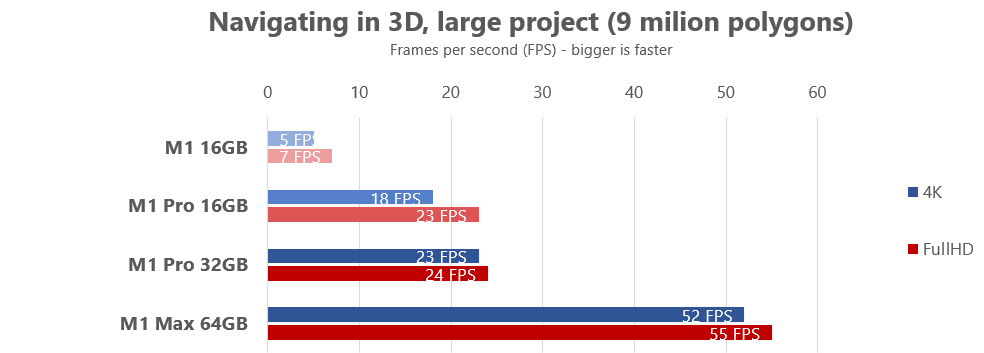
 When it comes to 3D navigation, due to the system limitations, we consider 60 Frame-per-second as the highly recommended level, whereas 30 Frame-per-second is acceptable for smooth navigation.
With small to medium models, the M1 Pro can easily handle 3D navigation.
 When it comes to large projects, we might see some stuttering behavior since the GPU struggles to render the frames smoothly. However, 24FPS is still an acceptable result. Meanwhile, the M1 Max with 64GB of memory can handle large projects with ease.
Limitations
The M1 Pro/Max has overcome most of the original M1 processor's limitations. However, there are a few things that may pay attention to when choosing:
- The M1 Pro is limited to 32GB of memory. If you need more than that, the only option is to go with M1 Max with 64GB of memory.
- External GPUs are not yet supported on this platform.
- Windows ARM emulation is supported on Apple Silicon for Mac via some third-party solutions, however, the performance of Windows ARM is not yet verified.
Recommendation
You may consider buying a Mac with an M1 Pro chip if:
- 32GB of memory is enough for your workflow
- The rendering solutions you are using do not rely on GPU performance
- Battery life is essential, as the M1 Pro should last longer than the M1 Max
The M1 Max can be beneficial if:
- You need 64GB of memory for your projects
- You use rendering solutions that require GPU performance
- You want the latest, strongest processor from Apple in a portable form factor